Twenty Years, Five Apartments, One Overdue Book: What I Owe the Cleveland Public Library
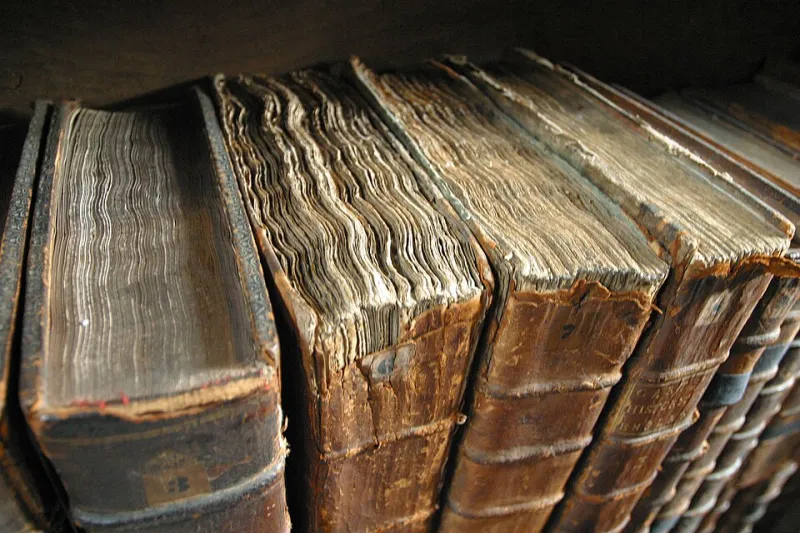
Photo: Tom Murphy VII, CC BY-SA 3.0, via Wikimedia Commons
The book sits on my shelf right now, or rather it sat there until three weeks ago, because I finally did the thing. I returned it. After twenty years. The Cleveland Public Library and I have finally settled our accounts, and I want to tell you about it, because I think the shape of this small debt says something about the shape of me.
The Book That Outlived Five Addresses
It was 2005. I was a sophomore, home for winter break, and I checked out Marilynne Robinson's Housekeeping from the CPL branch on Furk Avenue because a professor had mentioned it once and I liked the way the title promised domestic order to a person who had none. I read it in two days on my parents' couch. Then I went back to school. Then I graduated. Then I moved to Chicago, then Queens, then Brooklyn twice, then a duplex in Minneapolis with a landlord who mowed the lawn in his bathrobe.
The book came with me to every single one.
I want to be clear: this was not a heist. I never planned to steal it. It's just that somewhere around the third apartment, returning it stopped being an errand and started being an identity. The due date slip in the back — the paper kind, stamped in fading red ink — read something like 12/29/2005. By 2015, that date felt less like a deadline and more like a birthmark. By 2020, I genuinely could not tell you where the book ended and I began.
The fines, by the way, stopped accruing long ago. Most library systems cap or forgive overdue fees once they'd exceed the replacement cost, and eventually many just mark the item lost. So the debt became symbolic. Which, as any Catholic or former Catholic will tell you, is the heaviest kind.
Everybody Has One
Once I started paying attention, I discovered I was not alone. Not even slightly.
My friend Marcus has had a Copy of the Thelonious Monk record Brilliant Corners since 2009, borrowed from a college radio station DJ who has since moved to Portugal. The DJ knows. Marcus knows he knows. Neither of them has mentioned it in over a decade, which Marcus describes as "a long conversation conducted entirely in silence."
My neighbor Ruth, who is seventy-eight, still has her mother's library card from the Elyria Public Library, laminated now, kept in a recipe box. Her mother died in 1994. Ruth cannot return the card to anyone, because the person it belonged to is gone and the branch itself closed in 2011. So she keeps it the way you keep ashes: not because it's useful, but because it's evidence.
And then there's my cousin Dev, who borrowed a gray scarf from a girl in a Sacramento coffee shop in 2013 and married her in 2016. The scarf lives in their closet. He refers to it as "the deposit." She refers to him as "the collateral." They are, I'm pleased to report, disgustingly happy.
What all these objects have in common is that they were never really ours, and that's exactly why we kept them. Owning something is a closed loop. You buy it, it's yours, the story ends. But holding something — carrying it, tending it, moving it up the stairs of a walk-up in Bushwick because it's the only book you'd fight a fire for — that's a story with no last page. The debt isn't the burden. The debt is the relationship.
The Return
I could have mailed the book. I know that. I could have slid it into the after-hours drop slot like a coward and driven home feeling efficient. But twenty years felt like it deserved a face.
So on a gray Tuesday in October, I walked into a Cleveland Public Library branch carrying Housekeeping in my tote bag like contraband, which, technically, after two decades, it sort of was. I rehearsed a speech in the car. I planned to explain about the moves, the boroughs, the duplex, the symbolic nature of the debt. I planned to offer to pay for the book. I planned, honestly, to be forgiven.
The librarian — her name tag said Denise — took it from me, turned it over, and looked at the date stamp.
"Oh, we don't even use this system anymore," she said. "This is from before we went digital." She paused. "We stopped charging overdue fines entirely in 2021. Late fees mostly just kept people from coming back."
I stood there, clutching my prepared speech about devotion and debt, and felt it dissolve into something much simpler. "So I don't owe anything?"
"You owe it," she said, tapping the cover. "And now it's paid."
Then she put it on the cart to be reshelved, and a stranger will check it out next week, and the whole thing will start over with someone else. Which is, I think, the entire point of a library: it's the only institution built on the premise that everything you love should eventually leave you and come back changed.
What I Actually Kept
Here's the strange coda. I walked out of that branch feeling lighter, yes, but also oddly bereft, like I'd returned a rented tuxedo after a wedding I never wanted to end. For twenty years, that book was proof that a version of me existed — the one on the winter break couch, the one in the dorm, the one who was about to become everything she hadn't become yet.
I don't need the proof anymore. I am the proof. The person who read it and the person who returned it are separated by five apartments and most of a life, and both of them, somehow, were holding the same small borrowed thing.
Ruth still has her mother's card. Marcus still has the Monk record. I hope they keep them forever. Some debts aren't meant to be settled. Some are just meant to be carried — gently, from address to address, like a light left on for someone who might still come home.