The Laminated Badge in My Desk Drawer, or Why I Keep Evidence of My Bravest Self
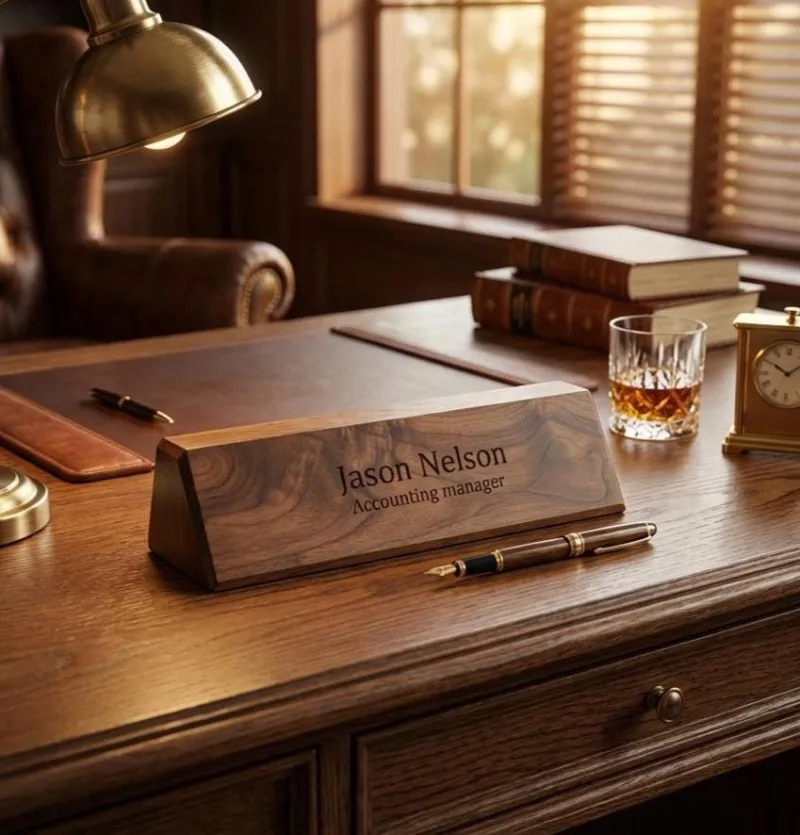
Photo: laminated conference name badge on wooden desk drawer, via i.etsystatic.com
It's in the second drawer of my desk, underneath a tangle of charging cables and a tin of buttons I keep meaning to sort: a laminated conference badge from October 2016. The photo is terrible — I look like I'd been crying, which, now that I think about it, I probably had been. The name is printed in a font that tries very hard to look important. ANJALI TYAGI, ATTENDEE. Below it, in smaller letters, the name of a writers' conference in Chicago that cost me two months of grocery money and a red-eye from Portland.
I have moved this badge three times. Once across the country, once down the coast, and once just across town, which somehow felt like the most dramatic move of all. Each time, I see it, I hold it for a second, and I put it back in the drawer. I have never once considered throwing it away.
The Thing About Evidence
Here's what I want to say about artifacts like this: we get them wrong. We file them under nostalgia, that soft-focus word we use for anything that hurts a little. But nostalgia implies you want to go back. That's not what the badge does for me. The badge doesn't make me miss 2016. 2016 was, frankly, a disaster — I was twenty-four, underemployed, and living with a roommate who microwaved fish. What the badge does is something stranger and more useful.
It's proof. Documentary, laminated, terrible-photo proof that at one point in my life, I did a brave thing badly.
Because that's what that conference was. I didn't know anyone. I hadn't published anything. I attended a pitch session where I described my novel-in-progress to a literary agent who nodded the way you nod at a child's drawing, and afterward I sat in my rental car in a Chicago parking garage and called my mom and cried. And then — this is the part that matters — I went back inside for the afternoon session. I have no memory of what the session was about. I only remember the going back.
A Contract, Not a Souvenir
I've started thinking of objects like this as contracts rather than souvenirs. A souvenir says: remember this? A contract says: you agreed to something, and I'm holding you to it.
When I signed up for that conference, I made a deal with a version of myself who hadn't yet learned to hedge. That version paid real money she didn't have. She got on a plane alone. She pitched a novel to a stranger with her voice shaking. And whatever happened afterward — the abandoned draft, the three years of not-writing, the slow return — some clause of that agreement never expired. The badge is the fine print.
I think everyone who's ever tried to make something has one of these objects. A friend of mine keeps a flyer from an open mic night in Albuquerque where she performed to an audience of four people, two of whom were the other performers. Another friend has a business card from a job he quit after nine months, kept not because he misses the job but because quitting it was the first decision he ever made entirely for himself. These aren't trophies. Most of them document failures, or at least non-successes. But they document attempt. And attempt, it turns out, is the rarest thing we produce.
The Gap Between Selves
What unsettles me, in a good way, is the distance between the woman on that badge and the one writing this. She thought success had a specific shape: an agent, a book deal, a spine with her name on it visible from across a bookstore. I know now that the shape is lumpier, that it looks more like this website, these essays, a life built out of small consistencies instead of one big arrival.
And yet I resist the urge to look down at her, that badge-wearing crying-in-a-parking-garage version of me. She was wrong about a lot of things, but she was right about the only thing that mattered: she thought she was a writer, and she acted like it, and acting like it is the whole job. Everything I've built since stands on that weekend in Chicago. She did the embarrassing part. She did the part I'd be too proud to do now, and that's exactly why I keep her badge where the charging cables live — somewhere I'll stumble on it regularly and remember what the tuition was.
Keep the Receipt
If you have one of these objects — and I suspect you do, folded into a passport somewhere, taped inside a closet door — I'm not going to tell you to frame it or throw it out. I'll just suggest you look at it once, honestly, not as a relic of who you were but as a receipt for something you purchased: a risk, once taken, that you're still spending down.
The badge stays in the drawer. Not displayed, not discarded. Just kept. Some contracts don't need to be framed. They just need a signature, and a witness, and a drawer that travels with you.