Confessions From the Bottom Drawer: A Love Letter to My Failed Drawings
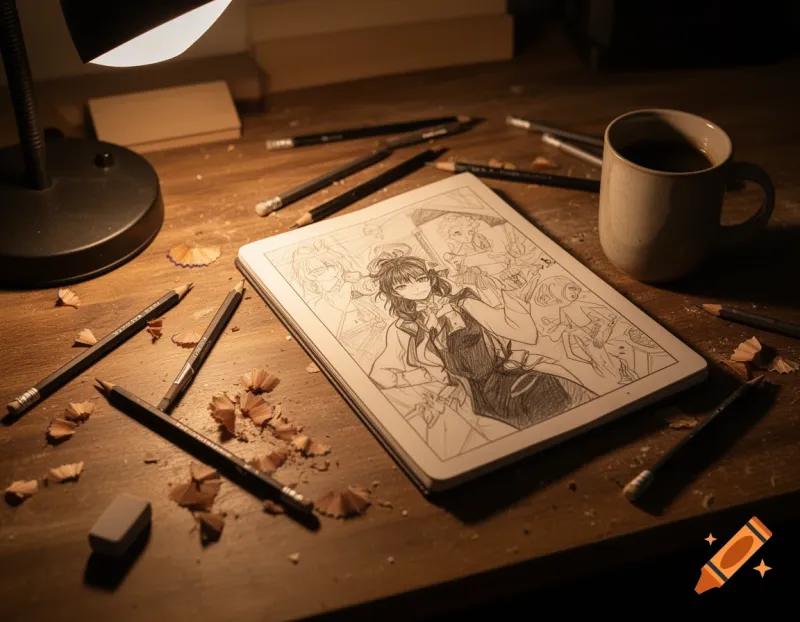
Photo: open messy sketchbook with pencil drawings on wooden desk, via media.craiyon.com
There's a sketchbook in my closet that I keep meaning to throw away.
It's from about six years ago, back when I was convinced I was one online course away from becoming a Real Artist. The drawings inside are stiff, overworked, and shaded within an inch of their lives. There's a hand on page twelve that looks less like a hand and more like a glove filled with hot dogs. I've flipped past it many times, wincing, and moved on.
But I've never actually tossed it. And lately, I've started to wonder if that's on purpose.
The Pages Nobody Claps For
We live in a highlight-reel economy. Instagram lets you post only the finished piece. Portfolio sites let you curate down to the pixel. Even the humble artist Instagram has a language of polish—the flat lay, the time-lapse, the "swipe to see the process" that conveniently starts after the ugly part.
What never makes the feed is the graveyard. The abandoned character study from the fifth page of a sketchbook. The essay draft titled "FINAL_final_v7" that will never, ever see daylight. The half-painted canvas turned to face the wall like it's being punished.
Here's my heretical opinion: that graveyard is the actual archive. The finished work tells you who you are. the rubble tells you who you've been.
What My Worst Page Taught Me
A few months ago, in a fit of pre-spring-cleaning energy, I actually sat down and read that awful sketchbook like a document. Not art—evidence.
And you know what I found? Page by page, I could watch myself figure things out. The hands got less like gloves. The faces stopped all looking like distant cousins of each other. Around page forty, I stopped outlining everything in nervous ink and started letting a drawing breathe.
The improvement wasn't in the good pages. The good pages were just the receipt. The improvement lived in the sixty bad ones leading up to them.
I think we have this backwards in creative culture. We treat failure pages as waste products—stuff to delete, shred, or hide before anyone important sees it. But a failure page is a data point with feelings attached. It's a record of a specific decision you made: I tried this, it didn't work, here's what I learned. A finished piece can't tell you that. It just sits there, being finished.
Curating the Rubble
I'm not saying frame everything. Some of my old work deserves a dignified burial. But I've landed on a few rules for dealing with creative wreckage:
Don't delete on a bad day. The draft that looks like garbage at 11 p.m. on a Tuesday might look salvageable on a Saturday morning. Distance is a better editor than despair.
Keep one "shame sketchbook" at all times. Mine lives in the closet, but it stays. It's not a trophy—it's a measuring stick. Whenever I feel like I haven't grown, I flip through it and get violently corrected.
Reread failures for patterns, not pain. When I look at old rejected drafts now, I don't look at whether they were good. I look for what I was avoiding. Every abandoned project I've ever had was abandoned right before it asked me to do something hard. That's useful information.
Let some things go. Not every failure is a teacher. Some failures are just Tuesday. You're allowed to crumple the page and move on without extracting a lesson. Not everything needs to be content.
The Portfolio Nobody Sees
If I could build the website I actually want, it wouldn't be a portfolio at all. It would be a museum of the almost—half-finished things, wrong turns, drawings of hands that are definitely hands this time, I promise.
Because that's the honest version. That's the version another struggling creative would actually find helpful, instead of the shiny finished pieces that make them feel worse.
The sketchbook is still in my closet. It's staying. Not because it's good—God, it is not good—but because it's proof. Proof that the person who made the work I'm proud of now had to slog through all of that first, one hot dog hand at a time.
Your worst pages aren't the cost of your creative life. They're the ledger. Keep the receipts.